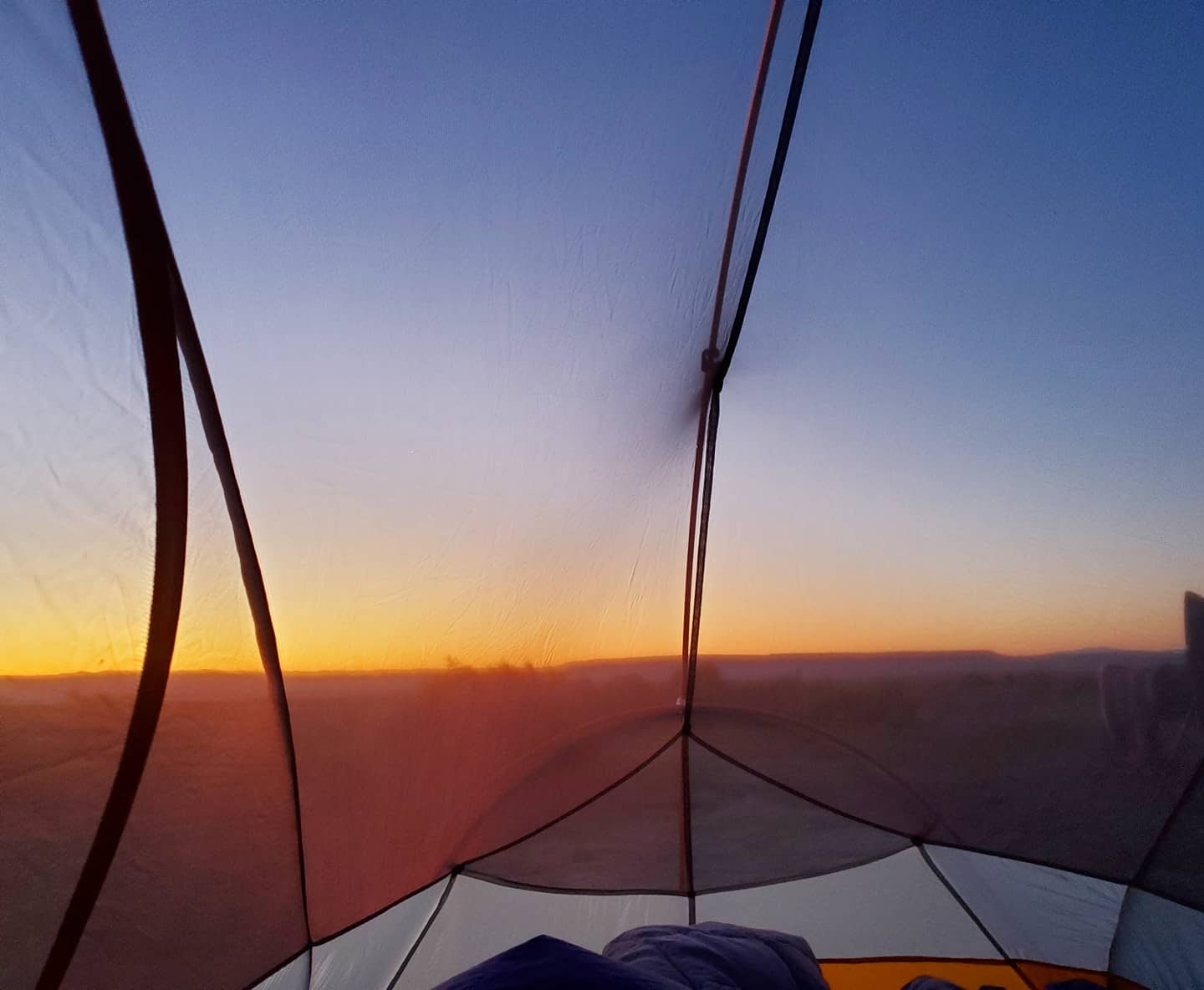
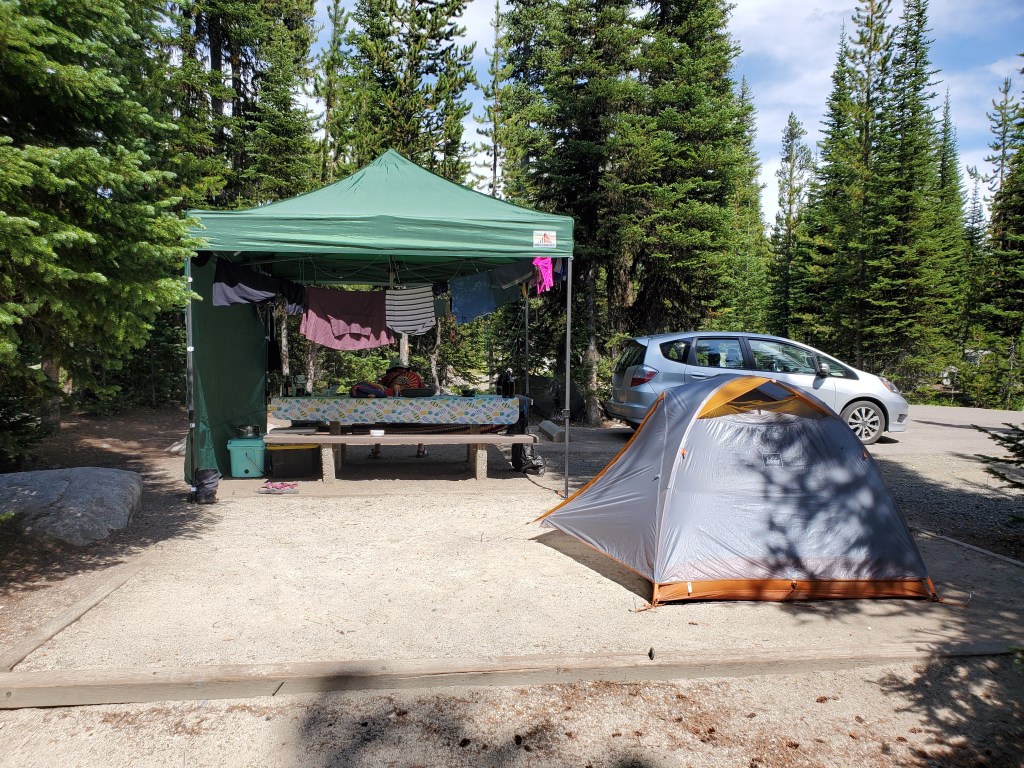
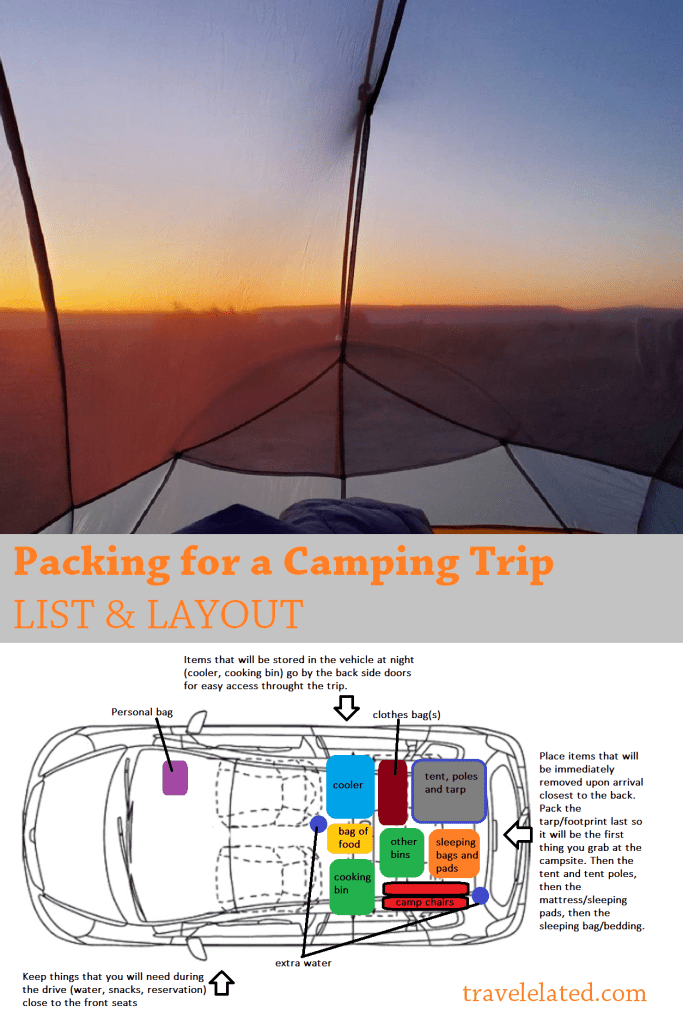
Below is our packing list for car-camping trips, or when the car is going to be directly at the campsite. We use this list for a late-spring to early-fall camping weekends in the Pacific Northwest. Many of these items are by no means necessary: tablecloths, pop-up trash bins, and 10’ x 10’ shelters are not must-haves for a first time camper. I’ve also included a layout of roughly how I like to pack the car for ease of unpacking and access while at the campground.
This seems like a good time for a disclaimer: please keep in mind that I am not a wilderness professional. These recommendations are based on my personal experience. Always read up on where you will be going and any specific recommendations by the hosting agency and local jurisdictions. Check driving and weather conditions before you leave home. Check out the disclaimer here.
- Full gas tank
- Small bag/purse, fanny pack, or small backpack, containing:
- Wallet
- Lip balm
- Sunglasses
- Cash for emergencies and for buying firewood, if applicable
- Printed campground information, in case reception is lost
- Phone
- Car phone charger and/or cables
- Water bottle for each person
- If there is not potable water at the campground, a water jug with ample water for drinking, cooking, washing up and hygiene
- If potable water is available, we still bring larger vessels for carrying water back to the site (we bring two 64oz glass growlers for this)
- Tent (including poles, rainfly, stakes, and footprint/tarp)
- Sleeping pads or mattress (and pump, and possibly batteries for pump, if applicable): check that R-value is appropriate for how cold it will be at night
- Sleeping bags: check that R-value is appropriate for how cold it will be at night
- Cocoons (optional, but nice if you camp often, it will be chilly, or to protect your sleeping bag from some grime)
- Pillows
- Fitted sheet for mattress (obviously optional), and I like to bring a down couch blanket to tuck up to my chin if there’s room in the car (personal preference and super optional)
- Cooking bin:
- Sponge
- Small container of biodegradable dish soap
- Skillet
- Cooking Pot
- Spatula
- Cutting board
- Sharp knife
- Plates, bowls, cups, mugs, utensils
- Paper towels
- Lighter or matches
- Small container of olive oil
- Salt and pepper
- Dish towel
- Ziploc bags
- If you like a caffeine boost in the morning: Tea bags, instant coffee, or pour-over or French Press and ground coffee
- Tablecloth (optional, but a nice barrier from the sap and bird droppings)
- Cooking stove and gas: we have a double burner Coleman for bigger groups/longer stays and a Jetboil for short trips
- Cooler with food
- Bag with non-cooler food
- Safety bin:
- Headlamps or flashlights (preferably headlamps)
- Trash bags; optional: pop up trash container(s)
- First aid kit
- Sunscreen
- Insect Repellent
- Toilet paper
- Crank radio (if going somewhere remote)
- Hand sanitizer
- Comfort bin:
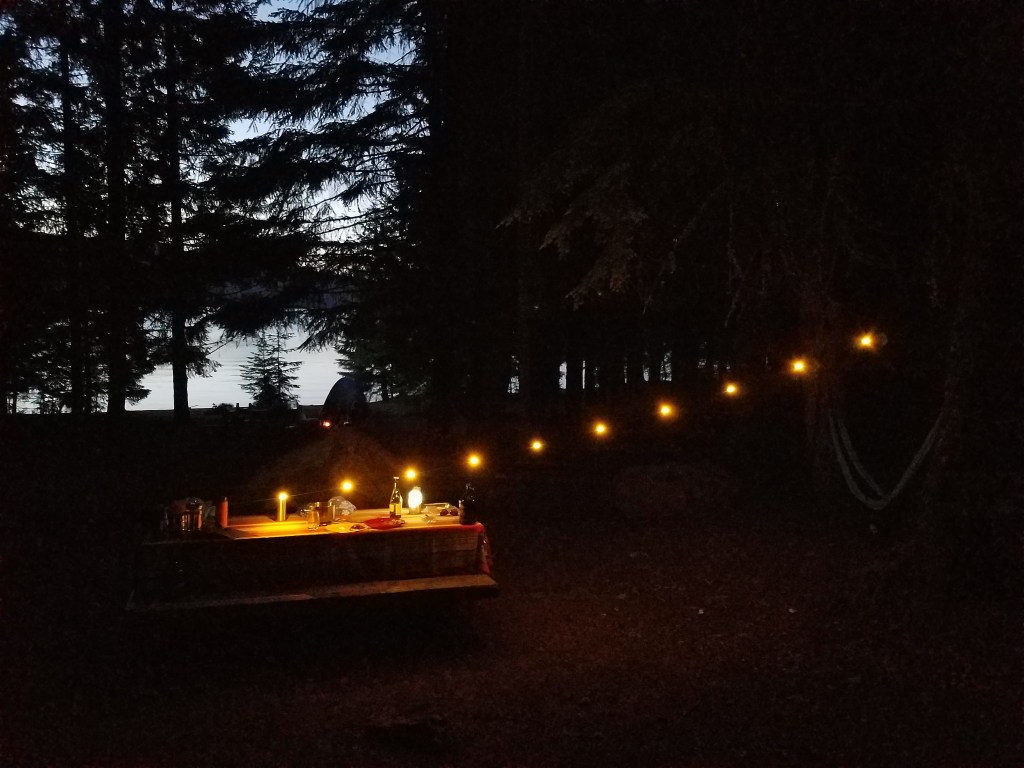
- Solar string lights or lantern(s)
- Cards or other compact games (choose games without pieces that will fall through picnic table cracks or blow away in a breeze)
- Mini dustpan and brush for removing debris from the tent
- Travel speaker
- Clothes bag(s):
- Plenty of underwear and warm socks
- Beanie to sleep in
- Gloves if it will be cold in the evening
- Clean set of soft pants (long johns/yoga pants) and top to wear while sleeping
- Clothes and shoes appropriate for your daytime activities (i.e. hiking pants and boots, swimsuit and water sandals); remember that cotton is not good in cold and wet conditions.
- Waterproof jacket
- Warm layer
- Toiletries
- Camping chairs (however, if there is a picnic table, you can also just sit on the provided benches – I suggest putting down towels as padding)
- Towels (even if you’re not planning on getting wet); I would suggest old towels that can be used to wipe down the tent.
- Camping shelter: We don’t typically pack one, but if you’re worried about rain or too much direct sun, they can be practical
- Daytime activities (i.e. books, hammock, guides, hiking sticks, inner tubes and pumps, camera, Frisbee, hammock and book, binoculars, marshmallow roasting sticks, fishing rods, life jackets, kayak and paddles, etc. depending on destination and interests)
- If you have a walk-in campsite, a cart might be useful, but only if the path is relatively wide and even.

Packing the Car: I like to pack the car in reverse order of what I anticipate pulling out (i.e. the sleeping bags go deeper into the car than the tent footprint, as I will need to set up the tent before I can put sleeping bags in it). I like to have the food bag and cooler by one of the rear side doors so that it is accessible for snacking, and since that’s where I will store it over night to keep animals away, accessible in the morning for making breakfast.
Elated Travel LLC is small Oregon-based business designed to help you get the most out of your next trip, big or small.
Elated Travel LLC is an Independent Affiliate of A. S. A. P. Cruises Inc., Florida Seller of Travel Ref. No. ST15578 – CST 2090937-50 – Washington UBID No. 603189022. Services not available to residents of Hawaii.
Copyright © Elated Travel LLC 2024 All Rights Reserved
 Elated Travel